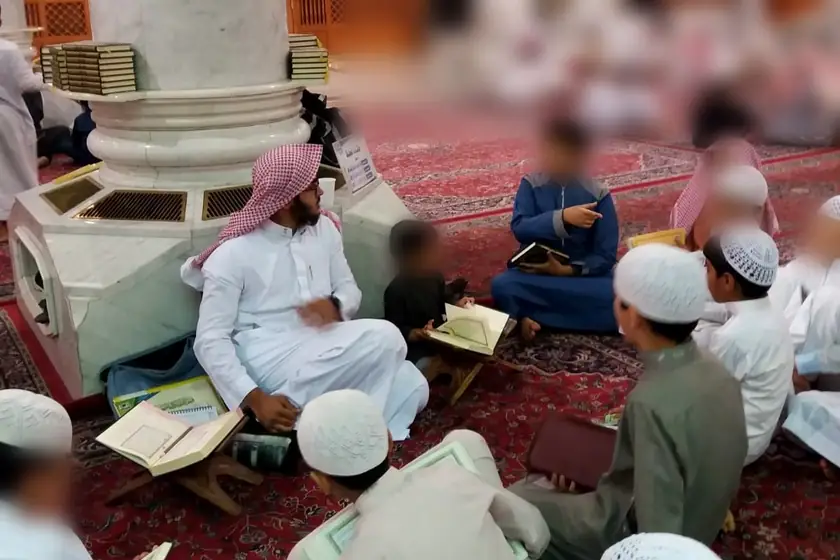
Assess Current Memorization Before Starting
The teacher reviews the student’s Quran reading, pronunciation, previously memorized surahs or juz, revision strength, and areas where mistakes or hesitation occur.
Memorize the Quran online through a structured Hifz program with personalized lesson targets, guided revision, and direct recitation correction. Learn with qualified teachers from Madinah and follow a plan designed around your current level, pace, and memorization goals.
Quran memorization is part of our broader personalized Quran learning program. Explore Our Online Quran Classes →
Our online Hifz program starts by assessing what the student already knows, then builds a structured memorization and revision plan around the student’s current level, available study time, retention strength, and long-term Quran memorization goals.
The teacher reviews the student’s Quran reading, pronunciation, previously memorized surahs or juz, revision strength, and areas where mistakes or hesitation occur.
The teacher sets a realistic amount of new memorization and revision according to the student’s ability, age, schedule, pace, and current retention level.
Strong and well-retained memorization is preserved, while weaker passages receive focused revision. Difficult ayat and Quran Mutashabihat can also be reviewed carefully to reduce confusion between similar verses.
When a student completes an assigned Hizb or Juz, the teacher assesses that portion before moving forward. If the memorization is strong, the student continues to the next stage. If weaknesses appear, they are reviewed and strengthened first.
A student who has already memorized several surahs, a few juz, a quarter, a third, or even half of the Quran does not have to begin again simply because they are new to Quranic Values. We first test the previous memorization, preserve what is strong, identify what needs reinforcement, and continue from the most suitable point.
The Hifz plan is not based on new memorization alone. The teacher balances new lessons with recent and older revision so the student can continue progressing while strengthening previously memorized Quran.
Each Hifz lesson follows a clear sequence so the student can recite new memorization, strengthen recent lessons, review older Quran, and prepare the next lesson correctly before memorizing it.
The student begins the lesson by reciting the newly memorized portion directly to the teacher from memory. The teacher listens carefully for memorization mistakes, hesitation, pronunciation, and recitation accuracy.
After the new lesson, the student recites the previous lesson or recently memorized portion. This helps the teacher check that recent Hifz is becoming stable rather than being remembered for only a short period.
The student then recites the assigned revision from older memorization. The amount is based on the personalized Hifz plan, current memorization strength, and areas that need additional reinforcement.
Before the class ends, the student reads the next assigned Quran passage directly to the teacher. Difficult words, pronunciation, Makharij, and important Tajweed points are corrected before the student begins memorizing that passage independently.
Memorizing a passage after its pronunciation and recitation have already been checked can make practice more accurate. The teacher can identify difficult words, Makharij, and relevant Tajweed rules before repeated errors become part of the student's memorization.
Hifz classes are based on completing the student's assigned tasks rather than simply filling a fixed time slot. A lesson may last up to around 25 minutes and can finish sooner once the required recitation, revision, correction, and next-lesson preparation have been completed properly.
A beginner, a child, an adult, and a student who has already memorized many juz do not need the same daily workload. The teacher adjusts new memorization and revision according to the student's ability, retention, available study time, and progress.
Memorization is not based on repetition alone. We guide students to engage with the Quran through careful listening, visual attention to the Mushaf, repeated recitation, and recall from memory. The teacher can adjust the amount of repetition according to the student’s age, ability, and memorization strength.
The student first listens carefully to the teacher during the live lesson and can continue practicing with recorded Quran recitations between classes. This helps the student become familiar with correct pronunciation, rhythm, Tajweed, and the sequence of the ayat before relying on memory alone.
While listening and reciting, the student is encouraged to look carefully at the Mushaf and notice the position, order, and visual structure of the ayat. This creates an additional visual reference that can support recall during revision and recitation.
The student repeatedly recites the passage aloud, first with support from the Mushaf and recording, then independently. The final stage is reciting from memory so the student can identify which parts are secure and which need more repetition.
One practical method we may use is a five-stage repetition cycle. The number of repetitions can be increased or reduced by the teacher when a student needs a different pace.
Listen to the assigned ayat carefully five times without trying to recite immediately. Focus on pronunciation, pauses, and the flow of the passage.
Listen again while following every ayah visually in the Mushaf. Pay attention to the order of the words and where the passage appears on the page.
Follow the recording while looking at the Mushaf and reciting the passage aloud. This brings listening, visual attention, and active recitation together.
Read the passage aloud from the Mushaf without the recording. This checks whether the student can reproduce the pronunciation and sequence independently.
Finally, recite the assigned passage without looking at the Mushaf. Any hesitation or repeated mistake shows the student which ayat need another cycle of focused practice.
Quranic Values provides recorded recitations that students can use between lessons. The current collection includes Surah Al-Fatihah and the short surahs from An-Nas through Al-A'la. These recordings can support correct memorization, Tajweed practice, pronunciation, and a more confident recitation style.
Different memorization problems require different solutions. Teachers can use additional tools when a student struggles with particular ayat, similar passages, or Tajweed during Hifz.
Similar ayat and expressions from different surahs can be organized and compared so the student learns where the wording changes and is less likely to confuse one passage with another during memorization or revision.
If a surah or group of ayat is particularly difficult to memorize, the teacher may explain the meaning and connection between the ayat in a simple way. Understanding the sequence can make the passage easier for the student to follow and remember.
Important Tajweed rules are introduced gradually during Hifz. Students can learn both the practical application and the relevant theoretical rule step by step, helping them memorize the Quran with more accurate recitation.
Difficult words, transitions between ayat, weak passages, and recurring mistakes can receive additional repetition rather than forcing the student to repeat every portion equally.
Younger students, beginners, advanced Hifz students, and students working with longer or more difficult ayat may need more or fewer repetitions. The teacher adjusts the method according to actual performance and retention.
Children and adults can join online Hifz classes with a personalized Quran memorization and revision plan based on their current level, available study time, previous memorization, learning goals, and ability to retain what they have learned.
Children receive manageable Quran memorization targets according to their age, reading level, concentration, and ability. The teacher keeps new Hifz and revision balanced so the child can progress gradually without being overloaded.
Adults can begin Quran memorization from their current level or return to previously memorized Quran that needs stronger revision. The Hifz plan can be adjusted around work, family responsibilities, available study time, and existing memorization.
Choose a monthly or 3-month Hifz plan and continue with personalized Quran memorization, supervised recitation, and structured revision.
A flexible monthly option for students who want personalized Quran memorization targets with regular revision and teacher feedback.
A longer learning period for students who want consistent memorization, organized revision, and stronger long-term retention.
Find answers about Hifz plans, revision, children’s memorization, adult learners, recitation correction, and the free trial.
Yes. Students begin from their current level. The teacher first evaluates Quran reading, pronunciation, memorization ability, and previous Hifz before setting suitable memorization targets.
Yes. Children from age 5 can join the program. Memorization targets are adjusted to the child’s age, level, concentration, and ability to retain previously memorized portions. A parent or guardian should remain nearby during classes for young children.
Yes. Adults can begin new memorization or strengthen portions they memorized previously. The teacher can adjust the plan around work, family responsibilities, and the student’s available study time.
There is no fixed target for every student. Memorization targets depend on reading ability, retention, available study time, revision needs, and individual progress.
Yes. Revision is an essential part of the program. Students review previously memorized Quran alongside new lessons to strengthen retention and identify weak portions that need more repetition.
Yes. Students who have already memorized parts of the Quran can follow a revision-focused plan designed to strengthen retention, improve recitation, and review weaker portions.
Yes. Teachers listen directly to the student during live lessons and provide correction in pronunciation, fluency, and Tajweed where needed as part of the memorization process.
Classes are conducted live through Google Meet. Students may also receive a personalized learning plan, relevant study materials, and a Google Sheet used to track memorization and revision progress.
Regular classes are offered five days per week from Sunday through Thursday. Class times are arranged according to teacher availability and the student’s time zone.
Yes. New students can begin with a complimentary 3-day trial that includes level assessment, learning-plan preparation, and the start of study according to the recommended plan.
Begin with a complimentary 3-day trial and level assessment, then choose a Hifz subscription plan and continue with personalized memorization, supervised recitation, and structured revision.
Choose the guide that matches your current question—whether you are preparing to begin, building a sustainable routine, strengthening revision, or selecting a structured online Hifz programme.
Build the right foundation before increasing your daily portion.
Fit memorization and revision around real family and work responsibilities.
Identify weak retention, time pressure and tools that genuinely support learning.
Understand the programme options and the wider value of lasting Quran memorization.
Begin with a complimentary three-day trial and level assessment. Your teacher can evaluate reading, Tajweed, previous memorization and available study time before recommending a plan.

Why families trust Quranic Values
Quranic Values is an independent online academy and is not officially affiliated with Al-Masjid an-Nabawi.